For a year I watered my lawn by timer. Fifteen minutes on, fifteen minutes off. Twice a week. I thought I was being responsible because I wasn't flooding the place. What I was actually doing was guessing.
Then someone on a forum asked me a question I couldn't answer. "How many litres per minute does your tap push?"
I had no idea. I'd never measured it. I had a vague idea that garden hoses pushed "about 15 litres per minute" from reading Bunnings reviews on sprinkler kits. That was all I was working with.
So I went outside with a 9-litre bucket and a stopwatch.
The bucket test
Held the hose in the bucket. Started the water and the timer at the same time. Bucket filled in 5.04 seconds.
That's 107 litres per minute.
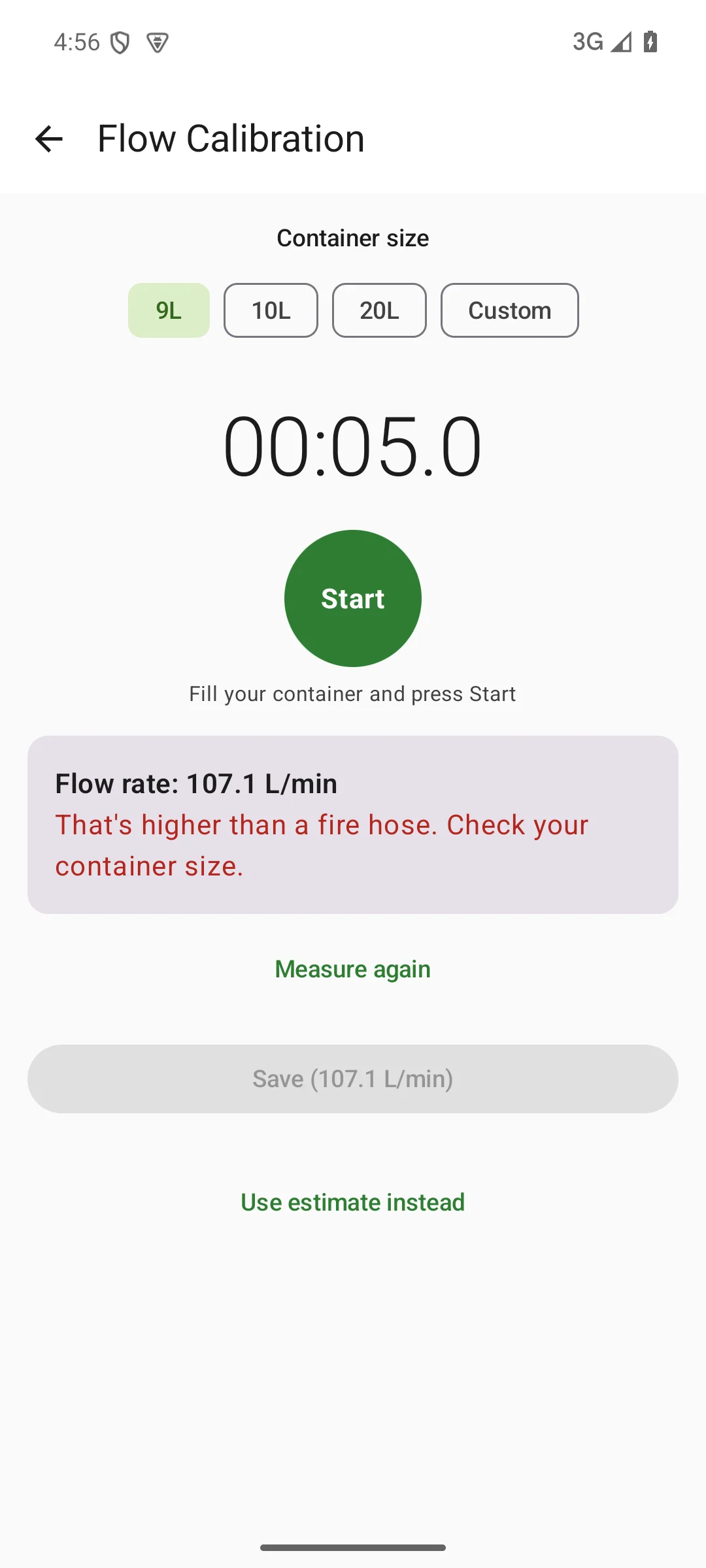
Yeah. That's way more than a garden hose should be pushing. My mains pressure in Coalfalls is stupid high, and the hose is a 12mm line with a wide-open nozzle and no restriction. The app I built even warned me on screen. "That's higher than a fire hose. Check your container size."
I re-tested with a 20L bucket and got a more reasonable 18 litres per minute using the spray nozzle I actually water with. But the point stood. I'd been assuming something wildly wrong about my own watering for months. Probably longer.
Why this matters on an Australian lawn
Most lawn care advice tells you your lawn needs a certain depth of water per week. Buffalo wants roughly 25mm per week in summer. Kikuyu wants about 20mm. Cool-season grasses like ryegrass and tall fescue want more. Those numbers show up everywhere.
But they're meaningless until you know two other things:
- Your actual flow rate in litres per minute
- Your zone area in square metres
With both, the maths is primary school stuff. One millimetre of water spread over one square metre equals one litre. So to deliver 25mm of water across a 200m² zone, you need 5,000 litres.
At 18 litres per minute, that's 278 minutes. About four and a half hours.
That's a lot more than fifteen minutes twice a week.
The second thing I got wrong
Even with the right total minutes, I was pouring water on too fast.
Coalfalls clay can absorb maybe 6 to 8 millimetres of water per hour before runoff starts. If I ran 18 L/min over a 200m² zone, that's 540 litres in 30 minutes, which works out to 2.7mm depth delivered at about 5.4mm per hour. Fine. The clay can take it.
But on a smaller 50m² zone at the same flow rate, 18 L/min becomes 21.6mm per hour over that zone. That's more than triple what the clay can absorb. The difference runs off my lawn, into the garden bed, onto the concrete, and out to the street. I was literally watering the weeds and losing the water that was supposed to be helping the grass.
The fix is called cycle-and-soak. Instead of running the sprinkler continuously, you run it for a short burst, stop, let the clay drink what you've just put down, then run another burst. Keep going until you've delivered the target depth. It sounds tedious and it is, but it's the difference between 18mm of water going into the soil and 18mm of water going down the storm drain.
How to do the bucket test yourself
You need:
- A bucket or container of known volume. 9 litres, 10 litres, 20 litres all work. Even a 2 litre milk jug works for low-flow setups.
- A stopwatch. Your phone stopwatch is fine.
- Your normal watering setup. The hose by itself is a different flow rate to the hose with a sprinkler. The front tap is probably different to the back tap. Test whatever you actually use.
The method:
- Put the bucket on flat ground where the hose reaches.
- Hold the hose or sprinkler nozzle so every drop lands in the bucket. This part matters. If you miss, your number is wrong.
- Start the stopwatch at the exact moment you turn the tap on.
- Stop both when the bucket is full.
- Calculate: flow rate in litres per minute = (bucket size in litres / time in seconds) times 60.
Write the number down. Stick it on the fridge. Do it for every watering setup you use, because they all behave differently.
What you do with the number
Once you have your real flow rate, you can work out:
- How many minutes to run each zone to hit your target depth
- Whether the clay can even absorb that without runoff
- Whether you should cycle-and-soak or just water continuously
- How your zones should be prioritised if you're on water restrictions and can only water one per day
This is exactly what Flow Calibration does inside LawnSuite. You enter your zone area, pick the target depth for your turf type, and it tells you the exact minutes to run your sprinkler. If your flow rate is too high for your soil type, it splits the session into cycles with soak intervals automatically. I built it because I got sick of doing the maths on the back of a fertiliser bag every time I wanted to change a zone.
See the full feature list for LawnSuite.
Quick reference for Queensland clay
For a 100m² clay zone targeting 15mm of deep-soak watering at an 18 L/min flow rate:
- Total water needed: 1,500 litres
- Total run time at that flow rate: 83 minutes
- Clay absorption rate: about 6mm per hour
- Actual time needed to absorb 15mm: 2.5 hours
- Cycle-and-soak plan: 4 cycles of about 21 minutes each, with 20 minute soak intervals between cycles
For the same 100m² zone over sandy soil with the same flow rate:
- Total water needed: 1,500 litres (same, sand doesn't change the target)
- Total run time: 83 minutes
- Sandy soil absorbs fast, no cycling needed
- One continuous session is fine
Clay and sand look identical when they're dry. They behave completely differently when you water them.
The punchline
I watered my lawn for a year based on a number I had never measured. A two-minute bucket test and one piece of grade 7 arithmetic saved me hundreds of litres per week and made my grass healthier. You would think someone would have mentioned this before. Nobody did.
If you are on Australian clay soil and your lawn goes brown at the edges while the middle stays green, you are probably watering too fast and losing water to runoff. Do the bucket test. The number will surprise you. Mine did.
Related guides
- How I killed my Couch lawn and started over with Sir Walter Buffalo - the renovation story that taught me all of this the hard way
- The complete Sir Walter Buffalo care guide - the watering section covers the depth targets by season
- Why I stopped mowing my Buffalo at 25mm - another mistake I made before I started measuring things
- Best lawn care apps for Australian homeowners - what I use and why
If you want the maths done for you instead of reaching for a calculator every time, try LawnSuite in closed beta. It's free while we fix the bugs.
Weather, soil data, treatment history, and dosage rates in one app. Built for Australian lawns.
Join the Android Beta — Free