
How LawnSuite decides when to water
A timer waters on a habit: the same schedule whether the week was cool and damp or hot and dry. LawnSuite instead estimates how much water your lawn has used, and only flags a session once the soil needs one.
Lawns don't use the same water every day
A hot, dry, windy day pulls far more water out of the soil than a mild, humid one, but a timer set to "twice a week" can't tell the difference. It either under-waters on the demanding days, or keeps watering on days the lawn didn't need it.
What FAO-56 measures
FAO Irrigation and Drainage Paper 56 is a published standard for reference evapotranspiration (ET0), the amount of water a well-watered reference surface loses to the atmosphere in a day, worked out from temperature, humidity, wind and sunshine. It's a common starting point weather and agriculture services use to estimate how much water any surface, lawn included, is losing on a given day. Read the FAO publication →
From hourly weather to a watering flag
LawnSuite pulls hourly FAO-56 reference evapotranspiration (ET0) for your zone's location from Open-Meteo and sums it into a total for each local day. That daily figure is scaled by a crop coefficient for your turf type, adjusted for the season; a lawn actively growing in warm weather uses more of that reference figure than the same lawn slowed by winter cold. The result accumulates as a soil-water deficit, tracked against how much water your soil can hold in the root zone: a function of your soil type's water-holding capacity and your turf's effective root depth. When that deficit reaches your zone's refill threshold, LawnSuite flags that a session is due and works out how long to run it, sized using your sprinkler's own application rate.
The watering card on your zone
The figures on the card are the outputs of that chain, alongside the application rate you set.
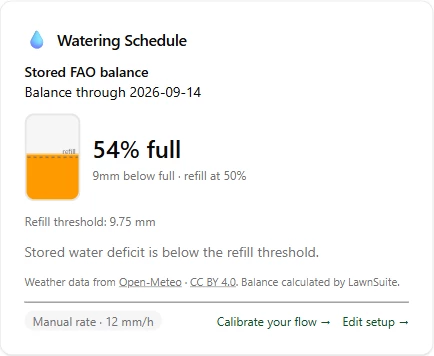
The card shows your zone's estimated stored balance, how many millimetres below full that is, the refill threshold that flags the next session as due, and the application rate the session is sized against, taken from a bucket-test flow calibration if you've run one, or a preset default for your watering method until you do.
What it needs from you. Your soil type and turf type set the water-holding capacity and crop coefficient the calculation runs on; both come from your zone setup. Your sprinkler's application rate is the other input: run a bucket-test flow calibration in the app for your own measured rate, or leave it on the preset default for your watering method until you do.
Your zone's water-holding capacity comes from the soil type you choose at setup.
Start free, schedule with Pro. Set up your first zone free and you'll see your local conditions straight away. Smart watering is a Pro feature: $149.99/yr (or $14.99/mo), with Founding Member pricing at $49.99/yr (renews at $49.99/yr). Your Founding price stays the same for as long as your subscription stays active. If you cancel after Founding closes to new sign-ups (at 100 paying subscribers, all plans), it can't be restored.
See your own numbers on Pro
Add your soil type, turf type and sprinkler rate, then upgrade to Pro and watch the deficit tracked from your local weather.
Try it free in your browser