
After days of rain in south-east Queensland, I've got leaf spotting in my Sir Walter Buffalo. I used LawnSuite's Diagnosis and Jed to look at the symptoms, gave Jed the four fungicides I had on hand, and used Impala. Here's what the photos show, why wet leaves matter, and what the product labels actually cover.
This is the same Sir Walter lawn in Ipswich that I wrote about in my renovation journal. The photographs here show the same area on 21 and 23 October. They record the lawn on those dates; they don't establish what caused the outbreak or how well a treatment worked. I suspect the area was already weakened by the renovation described in that post, although I don't know whether that contributed to the spotting.
What I saw, and what Diagnosis showed
Up close there are tan and brown spots, yellowing leaves and some uneven, frayed-looking leaf tips. The wider lawn still has plenty of green cover. That combination is why I wanted close photographs as well as a view of the whole area.
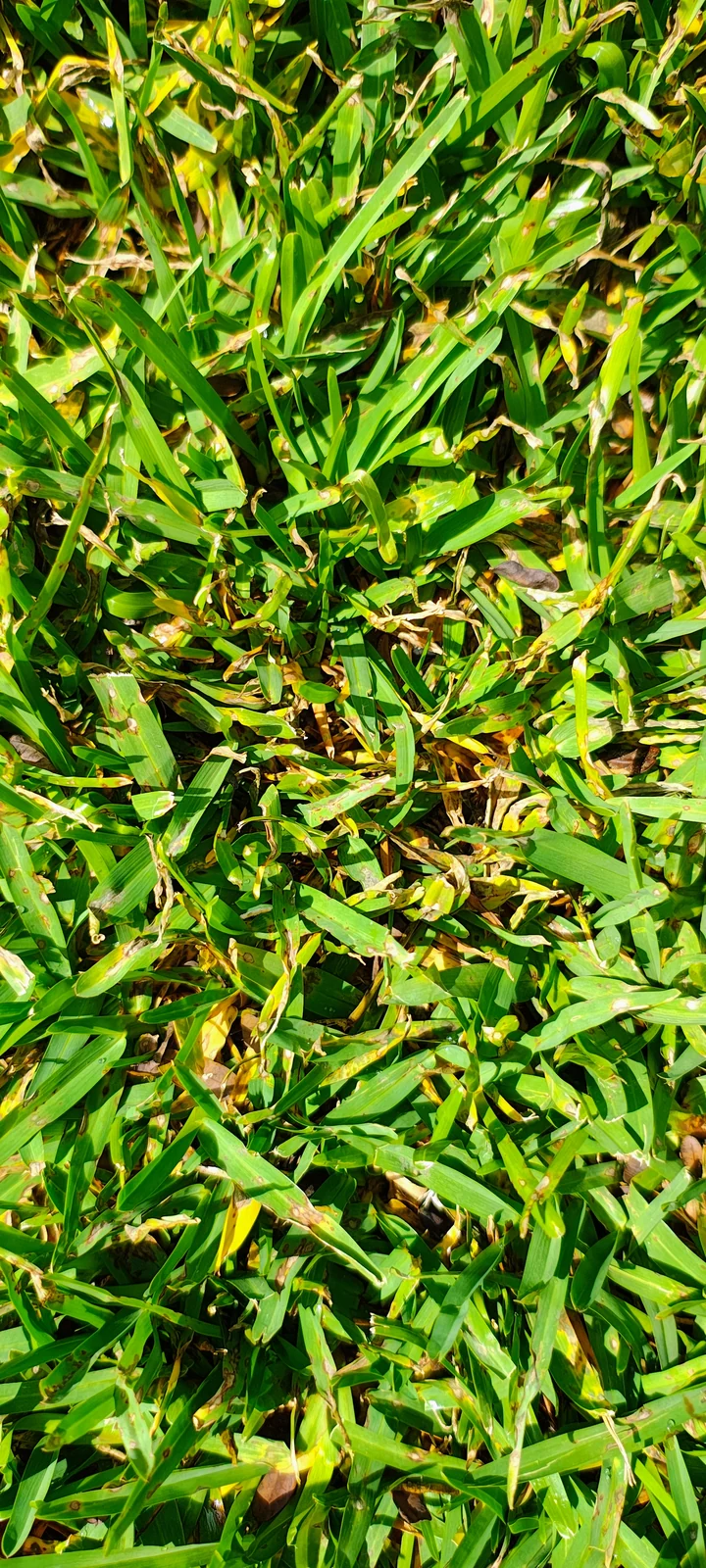
21 October: one of the photographs I used with Diagnosis and Jed.
The saved Diagnosis results from 21 October included Grey Leaf Spot scores from 78% to 85%, and a separate Leaf Spot / Helminthosporium result at 42%. Those are the model's scores from separate scans, not percentages of the lawn affected or a confirmed pathogen identification.
Australian research gives me a reason to keep Grey Leaf Spot on the list. Khemmuk's 2016 University of Queensland thesis identified Pyricularia oryzae, the fungus behind Grey Leaf Spot, from buffalo and catalogued older Queensland buffalo records of related blast fungi. The DNA-tested buffalo specimen was from Norfolk Island; the Queensland entries are older herbarium records. Impala's home-garden label uses the older name Pyricularia grisea for Grey Leaf Spot; I keep its disease names and directions as written in the label comparison below.
Hort Innovation's 2021 UQ report, TU19000, also recovered fungi from buffalo turf, including Helminthosporium-like fungi from a Sir Walter sample. That work investigated yellowing and poor root health on turf farms, without proving that the isolated fungi caused those symptoms.
For symptom descriptions, I'm using US extension guidance as support.
Grey Leaf Spot can produce elongated spots with pale centres and dark borders on Buffalo, called St Augustine grass in US sources. UF/IFAS's Grey Leaf Spot guide describes those features. The Helminthosporium group, including Bipolaris, Drechslera and Exserohilum, can also produce dark spots and lesions with bleached centres. The appearances overlap. I also asked Jed about black Helmo, so I'm keeping that alternative in the picture.
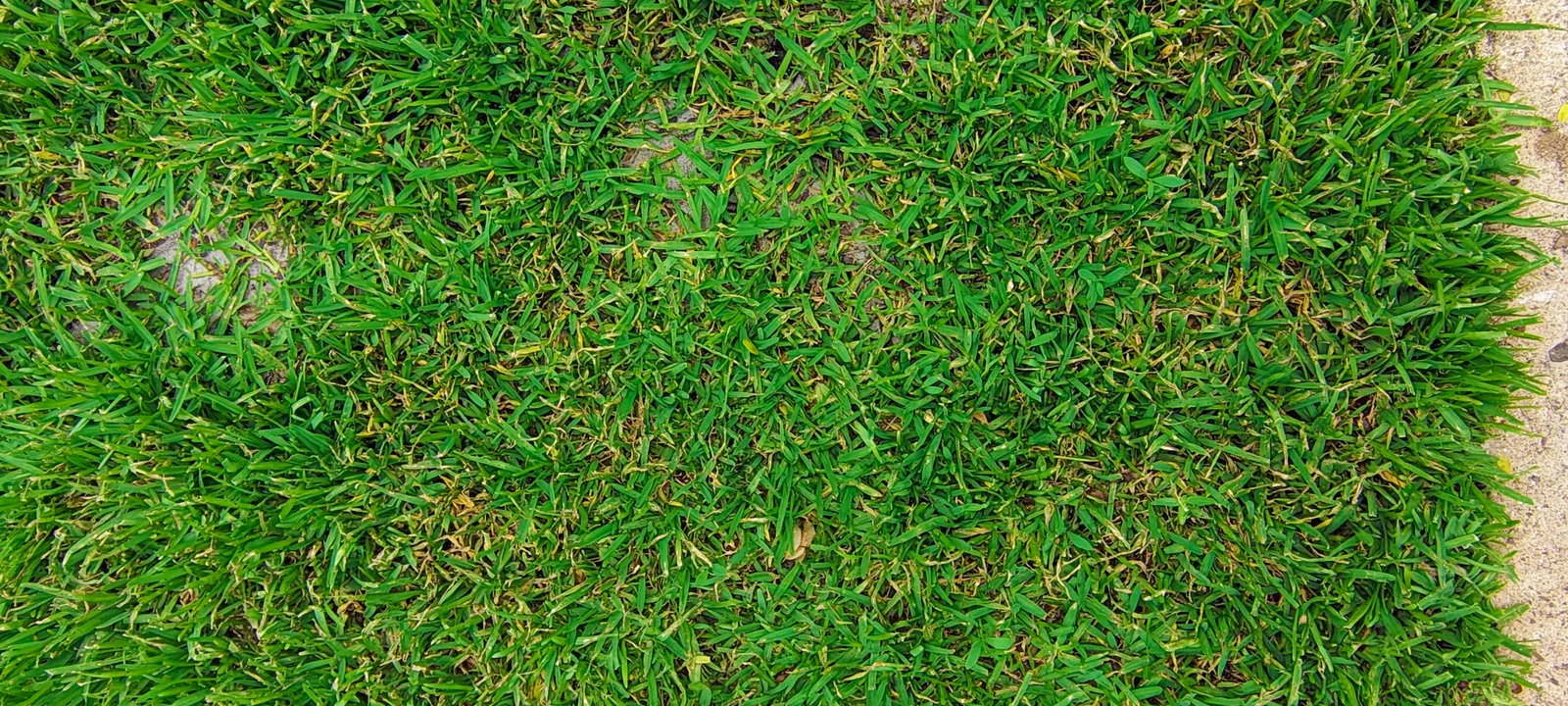
23 October: a wider view to go with the close-ups.
The wet spell behind the photos
When a long warm, wet spell is forecast I usually apply Impala preventatively, on a dry day at least three days before heavy rain, so it can dry on the leaf as the label requires. This time I didn't, so I could test how LawnSuite handled the outbreak.
I couldn't spray on 21 or 22 October because of persistent rain (BoM records rain to 9 am, so rain that fell after 9 am on the 21st appears in the 22 October row).
For a local weather reference, BoM's Amberley observations, station 040004, show the daily rainfall leading into the photographs, back to the preceding zero-rain entry on 17 October:
| Observation date | Rain in the preceding 24 hours to 9 am |
|---|---|
| 17 October 2026 | 0 mm |
| 18 October 2026 | 2.2 mm |
| 19 October 2026 | 10.6 mm |
| 20 October 2026 | 6.6 mm |
| 21 October 2026 | 1.4 mm |
| 22 October 2026 | 38.8 mm |
| 23 October 2026 | 76.4 mm |
That is six consecutive daily entries with rain, from 18 to 23 October.
On 22 October, Amberley's relative humidity was 95% at 9 am and 97% at 3 pm. These are station observations, read on 23 October, rather than measurements from my lawn. BoM's observation notes explain the rainfall day and that the current figures can be revised.
The useful question for leaf disease is how long the foliage stays wet between showers. Repeated rain, humid air and slow drying can keep that opportunity for infection open. The weather station doesn't tell me the number of wet-leaf hours in my yard.
UF/IFAS's Florida guide describes ideal Grey Leaf Spot conditions around 27–32°C with prolonged leaf wetness and very high humidity. BoM's Amberley table lists daily maxima of 20.3–26.4°C for 18–20 October, 28.0°C for 21 October and 21.4°C for 22 October. Only 21 October reached the guide's range, which limits that warm-weather comparison; the guide's ideal range isn't a diagnostic cutoff, and neither station data nor rainfall totals identify the fungus in my lawn.
Cultural changes that help the lawn dry and recover
The Australian TU19000 report discusses excess nitrogen, thatch and prolonged leaf wetness as risk factors, citing earlier turf disease literature.
- Check the mower blades. If the cut is tearing the tips, sharpen or replace the blades. Leave adequate leaf on Buffalo rather than scalping a spotted lawn. UC IPM's mowing guidance explains how mechanical damage and excessive leaf removal add stress.
- Water in the morning, when watering is needed. Check moisture below the surface before adding more water after rain. Avoid late-afternoon and evening irrigation that extends wetness through the night. This is about watering timing, not a direction to spray fungicide at sunrise. UF/IFAS explains the leaf-wetness link.
- Improve air movement and light. Trim back encroaching growth where practical and clear fallen leaves smothering the grass. UC IPM includes reduced shade and better air movement among Grey Leaf Spot prevention measures.
- Keep nitrogen measured. A heavy feed to force a quick green-up can encourage susceptible, lush growth. Equally, yellow leaves aren't a reason to starve the lawn indefinitely. Check nutrition alongside drainage, shade and disease before feeding. The Grey Leaf Spot and Helminthosporium guides both make nutrient management part of disease management.
For routine mowing and watering on this lawn, I've put the broader approach in my Sir Walter care guide.
The four fungicides I gave Jed, checked by label
The names I gave Jed were Impala, Solitaire 240 ME, Rapid Aqua 500 SC and Proplant. One name in that chat was shorthand: my bottle is Surefire Rapide Aqua 500 SC, APVMA 86311. Matching the complete pack name matters.
These are the APVMA e-labels checked on 23 October 2026. A disease name on a label and permission for the application site are separate checks.
| Product / label | Active and fungicide group | What that label covers for this comparison |
|---|---|---|
| Impala Fungicide, 80146/143065 | Azoxystrobin + triticonazole, Groups 11 + 3; dual systemic action | Its "Home Garden" directions cover turf/lawns and list both Grey Leaf Spot and Helminthosporium Disease. Buffalo isn't excluded, although Sir Walter isn't named separately. |
| ProForce Solitaire 240 ME, 80045/121590 | Metalaxyl-M, Group 4 | Label situation "Turf"; target "Pythium Leaf Blight, Pythium Root Rot, Seedling Damping off". Neither Grey Leaf Spot nor Helminthosporium is listed. This is a Pythium product, not an alternative for either leaf-spot candidate here. |
| Surefire Rapide Aqua 500 SC, 86311/127510 | Iprodione, Group 2 | Label situation "Recreational Turf". It lists Helminthosporium disease, but not Grey Leaf Spot. It also says safety to all turf varieties has not been tested. That recreational-turf entry doesn't establish home Buffalo use, so I'm not presenting it as an option for this home lawn. |
| Campbell Proplant, 51322/136337 | Propamocarb, Group 28 | Label situation "Recreational Turf" and target "damping-off on ornamentals and turf caused by Pythium spp." Neither Grey Leaf Spot nor Helminthosporium is listed. It doesn't establish a home-lawn use for this leaf-spot problem. |
CropLife Australia's turf resistance strategy includes Group 11 among the medium to high resistance-risk groups and advises rotation. Its guidance supplements the product label's resistance-management instructions.
What do the groups mean? Azoxystrobin interferes with fungal respiration; triticonazole interferes with sterol production. Metalaxyl-M acts on RNA production, iprodione on osmotic signalling, and propamocarb is associated with effects on membranes and fatty acids, with that mechanism described as proposed. The FRAC 2026 code list explains the classifications. Different group numbers don't make products interchangeable across diseases or application sites.
Impala and the backpack sprayer
On 23 October, at about 2:20 pm, I sprayed the front yard with Impala. I used the Impala bottle and Shindaiwa backpack sprayer pictured below. It had been raining in the morning, so I waited for a break after a few rain-free hours, when I judged the leaves dry enough to spray. I used Impala alone, without an adjuvant.
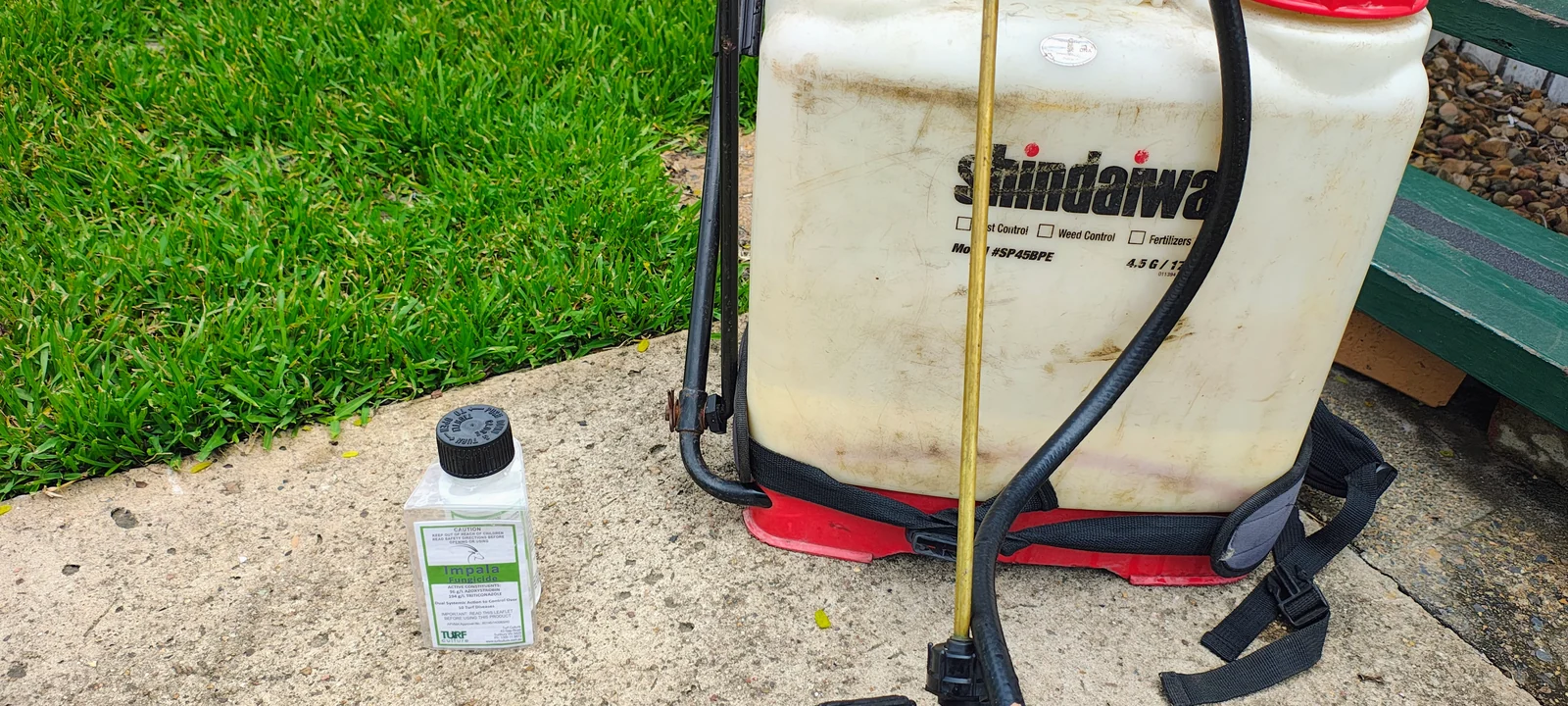
The Impala bottle and Shindaiwa backpack sprayer I used, photographed on 23 October.
Impala's home-garden label lists both of the leaf-spot candidates discussed here. For leaf and crown disease, it says "Allow the product to dry on the leaf and crown surfaces." Its home-garden precautions keep people and pets out until the spray has dried. It also rules out application to waterlogged soil or turf under heat or moisture stress, and application when heavy rain or storms likely to cause runoff are forecast within three days. See the complete home-garden directions and restraints, including the imminent-rain restriction, before choosing a spray window.
The label has separate leaf/crown and root-disease directions. Use the relevant row, application amounts, water volume and safety directions on your own pack. A backpack's tank size doesn't determine the amount of lawn it treats.
What I'm looking for next
It's too early to tell how the lawn has responded to the spray.
The useful follow-up is a comparison of the same area and fresh leaf growth: are new spots appearing, is the affected area expanding, and how is the lawn growing as the weather changes? The photographs on their own don't separate a treatment effect from drying weather or normal growth.
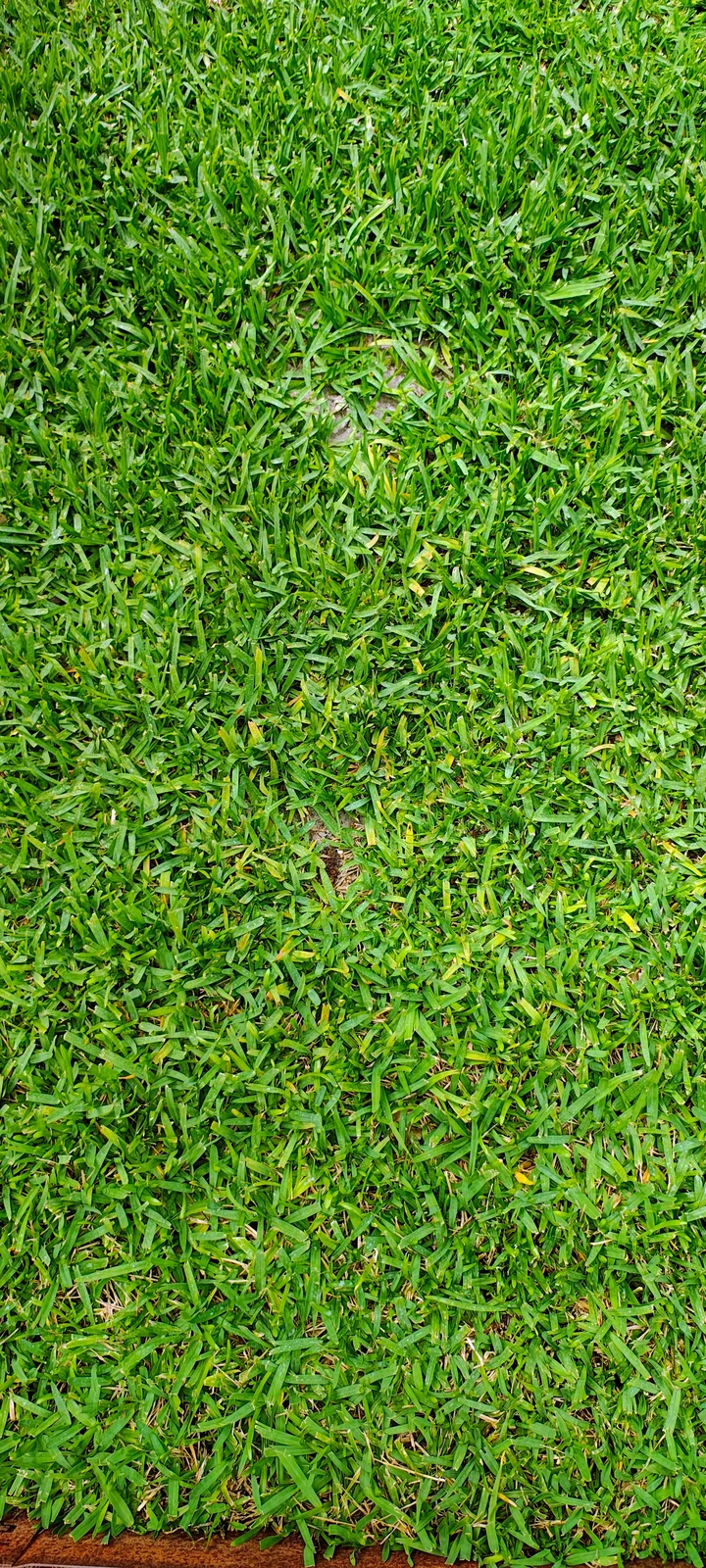
Another view from 23 October, kept with the outbreak record.
What helped, and what the beta missed
Diagnosis put Grey Leaf Spot and Helminthosporium on the list to investigate. Both can produce the kinds of leaf lesions discussed above, so the results gave me a useful starting point for comparing the close-ups. I still had to distinguish a model's match score from an identified pathogen: the photos and the different scores didn't settle which disease was present.
Jed helped me connect the spotting, wet weather and frayed tips with practical checks: look at the mower blades, avoid extending leaf wetness with unnecessary watering, and consider air movement and nutrition. Those points matched the turf-management sources linked above. Torn tips gave me a reason to check the cut; they didn't show that mower damage caused this outbreak. When I asked about black Helmo, Jed kept it in the discussion rather than treating the Grey Leaf Spot score as the end of the question.
For each bottle in my shed, I checked the APVMA label before deciding. Jed's summary of Impala (azoxystrobin and triticonazole) and Proplant (propamocarb, aimed at Pythium) matched the labels. The label check for this post confirmed that Impala's home-garden directions list both Grey Leaf Spot and Helminthosporium Disease. That supports its place in this comparison, without ranking its performance against the other bottles.
I asked this one in our Android beta, which doesn't yet link a chat to a specific lawn the way the web app does, so Jed didn't have my lawn's verified product list to work from. Solitaire and Rapide aren't in that verified list yet either, so I went to their labels. Solitaire 240 ME is metalaxyl-M, Group 4, with Pythium targets; Surefire Rapide Aqua 500 SC is iprodione, Group 2, with Helminthosporium on its recreational-turf label. I'd given Rapide a shorthand name, so I matched it to the full bottle name first. The comparison table above uses the label details, which matter for choosing between products and rotating resistance groups.
I checked the spray timing against the label too. Impala's label sets conditions on the spray window: a wind range and no hazardous surface inversions. Impala's label also says not to apply when heavy rain or storms likely to cause runoff are forecast within three days, and the forecast that afternoon showed heavy showers and possible storms ahead. So this spray didn't meet that restraint. Since the renovation (core aeration, then pumice, biochar, zeolite and a tonne of sand worked into the holes and across the surface) I haven't seen surface runoff, and the garden-bed edge drains through gravel and slotted pipe to an on-site soakage sump in the back yard. That observation doesn't override the label's three-day runoff-forecast restraint. Morning watering and a suitable fungicide spray window are separate decisions.
We're adding more products to Jed's verified label list, and for products outside it Jed will point you to the label. For this lawn, the follow-up is to keep the dated photos, disease possibilities, checked product identities and spray record together, then watch fresh growth and new lesions. That's how I can assess what happened as the weather changes, rather than treating a high match score as a diagnosis or one spray as proof that it worked.
Related journal entries
- Renovating my Sir Walter on heavy clay: part 1
- Sir Walter Buffalo care in SEQ
- Why I stopped mowing my Buffalo so low
Keep your lawn photos, products and observations together in LawnSuite.
Start Free in Your Browser